




Why do certain scents evoke an almost instantaneous sense of well-being? How can simple aromatic compounds influence our emotions the moment we perceive them? While these phenomena have long been considered purely subjective, neuroscience has now revealed a close link between olfaction and the brain. Thanks to a direct connection to the limbic system, olfactory information is processed in less than a second, making olfaction a unique sense among the five senses.
Thus, this special relationship between aromas and the brain forms the foundation of aromachology. This scientific discipline studies the influence of aromatic compounds—particularly those derived from essential oils—on emotions and well-being. A better understanding of the mechanisms of olfaction—and retro-olfaction in particular—is now opening up new avenues for the development of innovative sensory actives.
Understanding Retro-Olfaction: The Second Pathway for Smell Perception
Our perception of odors does not depend solely on what we breathe in. In fact, there are two pathways through which aromatic compounds reach the olfactory receptors located in the olfactory epithelium. (The specialized mucous membrane at the top of the nasal cavities, responsible for detecting odors. )
The first, called the orthonasal pathway, involves the perception of odors from the environment. This is the pathway we use when we breathe in or smell a scent, a flower, or food.
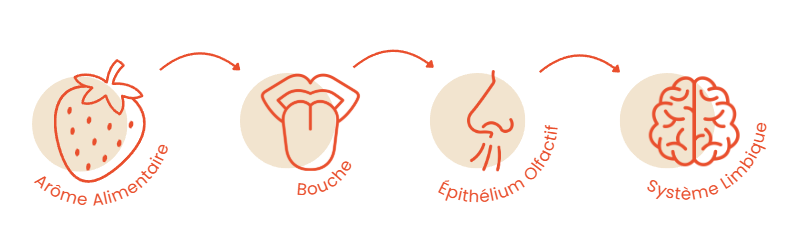
The second, less well-known but equally important, is the retro-olfactory pathway. When chewing or swallowing, the aromatic compounds released in the mouth naturally travel upward toward the nasal cavities. They pass through the nasopharynx before reaching the olfactory epithelium. There, they stimulate the same receptors as odors perceived through the nose.
Retro-olfaction plays a major role in the perception of aromas. It enriches our sensory experience by providing information that complements what is perceived by the tongue. It is this association between taste sensations and the aromatic molecules detected through retro-olfaction that gives “flavour” its full complexity.
Long studied for its role in the perception of food aromas, retro-olfaction is now attracting growing interest in the neurosciences. By allowing aromatic compounds to activate the olfactory pathways from the oral cavity, it offers a new perspective for better understanding the interactions between aromas, the brain, and emotions.
The Emotional Brain: How Scents Influence Emotions
Once detected by the olfactory receptors, aromatic compounds generate a nerve impulse. This impulse then travels to the olfactory bulb, the first brain structure involved in processing olfactory information. It is at this stage that the identification of odors begins, as well as their sensory and emotional interpretation.
What makes this pathway unique is its anatomical structure. Unlike sight, hearing, or touch, the sense of smell follows a more direct neural pathway. In less than a second, olfactory information reaches the brain regions associated with emotions, memory, and behavior. These regions are part of the limbic system. This rapid connection explains why an aromatic compound can elicit an immediate emotional response, such as a feeling of well-being or calm, or even trigger a memory.
The Limbic System: The Link Between Smells, Emotions, and Memory
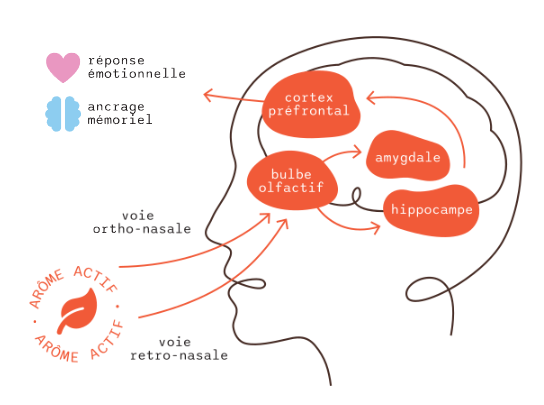
The limbic system consists of several complementary structures, including the amygdala and the hippocampus.
The amygdala plays a role in processing emotions and assigns emotional significance to sensory stimuli. In particular, it enables the brain to quickly assess whether a smell evokes a pleasant, reassuring sensation or, conversely, one that is potentially threatening.
The hippocampus, for its part, plays a vital role in the formation, storage, and retrieval of memories. Its interaction with the olfactory pathways explains why certain scents can instantly bring back very specific memories, sometimes associated with intense emotions.
This proximity between the olfactory system and the limbic system gives olfaction a unique status among the five senses. Even before we consciously identify a smell, our brain has already compared it to past experiences and assigned it an emotional dimension. Aromatic compounds are therefore not merely perceived; they are interpreted through our sensory memory, our experiences, and our emotional history.
This unique connection between olfaction and the brain now forms the scientific basis of aromachology.
Smells, the Brain, and Emotions: The Role of Aromachology
This knowledge has gradually given rise to a scientific discipline: aromachology. At the intersection of neuroscience, sensory physiology, and psychology, it studies how aromas—particularly those derived from essential oils—can influence emotions, behavior, and the sense of well-being.
Unlike aromatherapy, which relies on the pharmacological properties of essential oils for therapeutic purposes. Aromachology studies their sensory properties. Its goal is not to evaluate a biological or medical effect, but to understand how certain aromatic signatures are perceived by the olfactory system—and also how they can modulate emotional responses through the natural mechanisms of perception.
To explore these interactions, researchers use a variety of complementary approaches. Studies may combine sensory and emotional assessments provided by participants with physiological measures, such as heart rate and electrodermal activity. These indicators provide a better understanding of the body’s responses to an olfactory stimulus and allow researchers to study the links between sensory perception, emotions, and brain function.
This knowledge is now opening up new avenues for the development of sensory actives. By selecting aromatic compounds based on their sensory characteristics and their ability to stimulate the olfactory pathways—particularly through retro-olfaction—it becomes possible to design ingredients intended to interact with the natural mechanisms of perception.
Innolphae®: a sensory active ingredient based on the mechanisms of olfaction
With this in mind, we have developed Innolphae®, a sensory active ingredient derived from specific fractions of Citrus sinensis essential oil. Developed several years ago, it is based on current knowledge in aromachology and the neuroscience of olfaction.
Its mechanism is based on retro-olfaction: once released in the mouth, its aromatic compounds naturally travel up to the olfactory receptors located in the nasal cavities. The olfactory signal is then transmitted to the brain regions involved in emotions. This approach helps manage stress and promote a sense of emotional balance, without causing habituation or dependence.

To evaluate its use under conditions similar to those of daily life, Innolphae® underwent a validated user test involving 100 women aged 25 to 40. For 30 days, the participants took one lozenge daily containing 100 mg of Innolphae®. The results notably showed a positive perception of the product’s rapid onset of action, good sensory acceptability, and high compliance.
The example of Innolphae® illustrates how knowledge in the neuroscience of olfaction and aromachology can be leveraged to develop innovative sensory actives. By exploring the interactions between aromatic compounds, the emotional brain, and well-being, this approach opens up new avenues for the development of high-value-added ingredients.
At Phodé Human Care, we put this expertise to work for manufacturers to develop innovative sensory solutions, in which aromatic compounds contribute both to the products’ organoleptic profile and to the consumer’s overall sensory experience.
With the “2026 Trends decoded” series, each month we’ll bring you:
- A decoded trend,
- Practical tools
- Concrete guidelines
- Inspiring technical cases.
Next episode: MoodFood: An in-depth look at a trend that is redefining the connection between nutrition, emotions, and product innovation.
Send us your matrix to receive a personalized response within 48 hours.