




Why is aromachology emerging as a major driver of innovation?
Some smells immediately catch our attention. Others evoke a memory or subtly influence our perception of a product, without us even realizing it. Our sense of smell works discreetly, but it plays a full part in our consumer experience.
For a long time, aromas were studied primarily for their contribution to taste and organoleptic qualities. Today, research shows that they also play a role in perception mechanisms and emotional responses.
This is precisely what aromachology seeks to understand: how certain aromatic compounds, particularly those found in essential oils, interact with the olfactory system and influence the perception of a product.
The goal is not to attribute a systematic effect to a particular scent. Rather, it is to better understand the mechanisms that link olfactory perception, emotions, and sensory experience.
This knowledge now extends beyond the scientific realm to sectors such as the food and beverage industry and the nutraceuticals industry, where the flavor profile has become a key driver of product design.
The mechanisms of aromachology: from scent to emotion
What is aromachology?
Aromachology is a scientific discipline that studies the psychological and physiological effects of aromas on humans. It focuses specifically on aromatic compounds, particularly those found in essential oils, to understand how perceiving them can influence mood, well-being, or certain behaviors.
Unlike aromatherapy, which uses essential oils for therapeutic purposes, aromachology does not aim to treat. It seeks to observe, measure, and understand the responses triggered by olfactory stimuli. To do so, it draws on protocols derived from neuroscience, experimental psychology, and sensory science.
Aromachology thus makes it possible to identify the links between certain aromatic compounds and specific emotional or physiological states, as well as the conditions under which these effects can be observed.
From the nose to the brain: the journey of an aroma
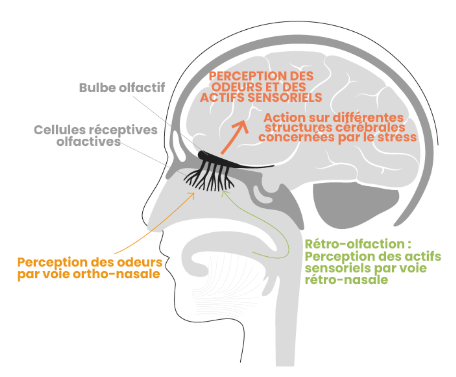
Every olfactory sensation begins when an aromatic molecule reaches the olfactory receptors located in the nasal cavity. These receptors convert the chemical signal into a nerve signal, which is then transmitted to the olfactory bulb, the first brain structure dedicated to processing olfactory information.
Unlike other sensory modalities, information received through the sense of smell then follows a particularly direct pathway. It quickly reaches the limbic system, which is involved in emotions, as well as the hippocampus, which is essential to memory processes.
This mechanism explains why a smell can trigger an almost instantaneous emotion, bring back a memory, sometimes a very old one, or alter our perception of a situation even before we are fully aware of it.
It is precisely this unique connection between the sense of smell and the brain’s emotional centers that forms the scientific foundation of aromachology.
How do aromas influence our emotions and behaviors?
Smells do not act solely through their pleasant or unpleasant nature. When we perceive them, they activate brain networks involved in regulating emotions, attention, and certain physiological states.
Research in aromachology shows that certain aromatic compounds, particularly those found in essential oils, are associated with recurring emotional responses. These include relaxation, stress reduction, increased energy, improved concentration, and sleep promotion. These effects are studied using physiological and psychological markers to understand the mechanisms behind them.
However, the response to an olfactory stimulus is never universal. It depends on the intensity of the odor, the context in which it is perceived, past experiences, and individual sensitivity.
Aromachology thus seeks to distinguish between effects related to the properties of aromatic compounds and those related to personal history. This approach provides a better understanding of the conditions under which certain aromas can help modulate an emotional or cognitive experience.
This knowledge thus opens up concrete opportunities for manufacturers, enabling them to enhance product formulations and design more consistent and distinctive consumer experiences.
Aromachology: a tool for shaping the consumer experience
Consumers seeking more immersive experiences
Consumer expectations are changing rapidly. While functional benefits remain essential criteria, they are no longer sufficient on their own to set a product apart. Consumers are now seeking more comprehensive consumer experiences that combine effectiveness, enjoyment, and well-being.
This trend is particularly evident in the food and nutraceutical sectors. Products marketed for stress management, sleep, energy, or concentration are on the rise, as are functional beverages and dietary supplements.
In this context, the sensory experience is becoming increasingly important. Smell, taste, and the sensations experienced during consumption all contribute to how a product is perceived and remembered. Manufacturers are therefore seeking to design products whose sensory experience is consistent with the promise conveyed by the formulation.
The insights gained from aromachology shed new light on this issue. By studying the interactions between aromatic compounds, the olfactory system, and emotions, they allow us to view the aromatic profile as a powerful tool for shaping the sensory experience.
Exisitng applications in functional products

This approach is no longer purely theoretical. It is gradually being applied to various product categories where the sensory experience plays a key role in perceived value.
In the functional beverage sector, some brands link specific flavor profiles to benefits such as energy, relaxation, or concentration. Meanwhile, several chocolate brands are exploring sensory worlds built around emotions or well-being, using flavor combinations to enhance the tasting experience.
The nutraceutical industry is also following this trend. Dietary supplements are now developed using a more holistic approach, in which the ingredients in the formulation and the sensory experience are designed to complement one another. The selection of flavor profiles, their intensity, and their alignment with the intended health benefit contribute to the product’s acceptability and perceived quality, and help ensure the coherence of the formulation as a whole.
Thus, these products reflect the same trend. Aromatic profiles are now viewed as components of the overall experience, rather than merely as elements intended to add flavor.
Essential oils: a source of inspiration for aromatic profiles
In this approach, essential oils play a special role. Rich in natural aromatic compounds, they are one of the main sources studied in aromachology to understand the links between olfactory perception and emotional responses.
The value lies not only in the essential oil itself, but in the aromatic molecules it contains. Some of these molecules are the subject of studies aimed at better understanding their influence on perception, mood, or certain physiological states when detected through the sense of smell.
This knowledge opens up new possibilities for the design of flavor profiles. It allows us to conceive of sensory signatures that are designed not only for their organoleptic qualities, but also for their alignment with the product’s intended use and the experience the consumer is seeking.
Aromachology, therefore, does not replace the work of fragrance creation: it provides a complementary framework that helps design consumer experiences that are more coherent, more distinctive, and better aligned with current market expectations.
From aromachology to product formulation
Turning knowledge into formulation solutions
While aromachology provides a better understanding of how aromatic compounds interact with the olfactory system and influence certain emotional or cognitive responses, its value also lies in the opportunities it offers for the development of new products.
In the food and nutraceutical industries, this knowledge allows us to approach the flavor profile from a different angle. Flavor is no longer selected solely for its taste qualities or to mask certain undesirable notes in a formulation. It has become a design element capable of reinforcing the alignment between the product’s promise and the consumer’s experience.
This is the approach on which sensory assets are based.
A sensory active ingredient is an aromatic composition developed based on knowledge derived from aromachology. It combines aromatic compounds—often derived from fractions of essential oils—selected not only for their sensory profile but also for their ability to support a specific intended use, such as relaxation, stress management, sleep, or concentration.
The goal is not to replace the nutritional or physiological ingredients in a formulation. Rather, it is to incorporate an olfactory dimension that is consistent with the desired benefit.
A new approach to formulation
This trend is gradually leading manufacturers to rethink the role of flavor in product development.
Traditionally, the flavor profile was used to improve the acceptability of a formulation, create a distinctive taste profile, or meet consumer expectations regarding taste. Now, it can also help enhance the consistency of the sensory experience.
In a beverage designed to promote relaxation, for example, the flavor profile can complement the benefits offered by the functional ingredients. Conversely, a product intended to boost energy or concentration might feature a different flavor profile, in line with the desired sensory experience.
This approach makes it possible to develop more cohesive products, in which the formulation, claimed benefits, and consumer experience all follow the same logic.
Beyond differentiation, it also meets current market expectations. Consumers are placing increasing importance on the quality of the experience, the naturalness of the ingredients, and the consistency between a product’s promises and the sensations it delivers.
Innolphae®: our line of sensory active ingredients
For many years, the teams at Phodé Human Care have been studying the interactions between aromatic compounds, the olfactory system, and emotions in order to better understand their impact on well-being and behavior.
This expertise is based on a unique approach: the use of the retro-nasal pathway as the preferred mode of action for sensory active ingredients. This pathway allows aromatic compounds to interact directly with the olfactory mechanisms involved in processing emotions. Building on this foundation, we develop sensory actives designed to combine a pleasant sensory experience with functional efficacy.
The result of several years of research, this approach has made it possible to identify aromatic molecules capable of exerting a measurable impact through the sense of smell. These studies led to the development of Innolphae®, a line of highly concentrated sensory actives derived from specific fractions of Citrus sinensis essential oil.
Innolphae® acts via the retro-nasal route on the areas of the brain involved in emotions and specifically targets serotonin-related pathways. This action helps manage stress and promotes a sense of emotional balance, without causing habituation or dependence.
By combining scientific expertise, flavor formulation, and an understanding of market expectations, we support manufacturers in developing products where the flavor profile plays a key role in the consumer experience and helps set their innovations apart.
Conclusion: aromachology as a new approach to the sensory experience
Long confined to the realm of research, aromachology is now finding practical applications in the development of food and nutraceutical products.
By incorporating sensory, emotional, and functional dimensions right from the formulation design stage, it opens up new possibilities. Aromachology thus makes it possible to design consumer experiences that are more cohesive, more engaging, and in line with today’s consumer expectations.
With the “2026 Trends decoded” series, each month we’ll bring you:
- A decoded trend,
- Practical tools
- Concrete guidelines
- Inspiring technical cases.
Next episode: MoodFood: An in-depth look at a trend that is redefining the connection between nutrition, emotions, and product innovation.
Send us your matrix to receive a personalized response within 48 hours.